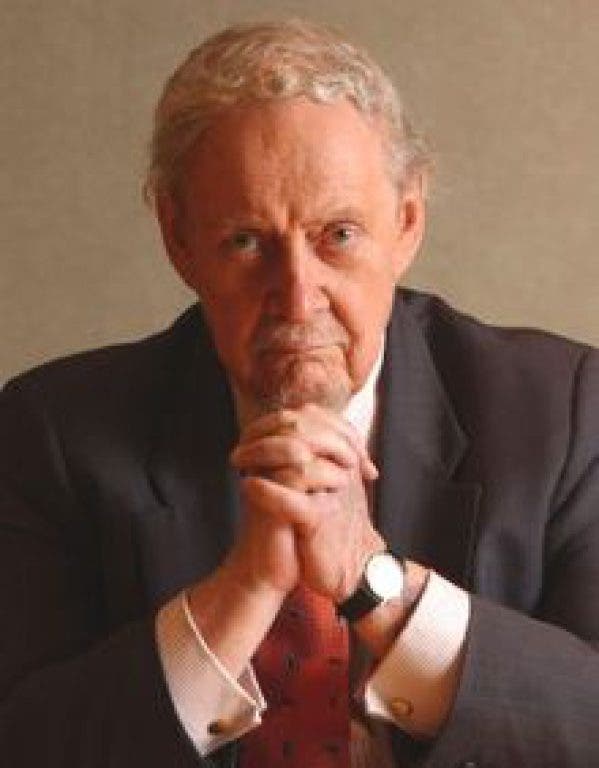
"Robert Bork's America is a land in which women would be forced into back-alley abortions, blacks would sit at segregated lunch counters, rogue police could break down citizens' doors in midnight raids, schoolchildren could not be taught about evolution, writers and artists could be censored at the whim of the Government, and the doors of the Federal courts would be shut on the fingers of millions of citizens“ --Senator Edward Moore "Ted" Kennedy (D – Massachusetts). July 1, 1987
Robert Bork died December 19, 2012, from complications related to heart disease, and thus passed away a brilliant originalist and a fiercely conservative legal mind of the last fifty years. His last public interactions were as a consultant to Mitt Romney in his presidential campaigns since 2007, and had the distinction of an eponymous verb entered in the dictionary on his behalf:
bork verb
obstruct (someone, especially a candidate for public office) by systematically defaming or vilifying them
What else did Bork do?
He crusaded against liberalism, blaming it for every conceivable ill that plagued the nation, with an astonishingly religious slant for a jurist. He frowned upon premarital sex, working mothers and bemoaned the moral decadence he attributed to the Left’s embrace of egalitarianism and individualism. His book Slouching Towards Gomorrah: Modern Liberalism and American Decline will probably gain posthumous acclaim, especially since it espouses many Tea Partiers’ vision of what America should be.
[It is $0.01, used, at Amazon. So grab it, Tea Partiers]
So was Kennedy wrong to, er, bork him like that?
Bork himself argued that Kennedy was, yet his expressed opinions on landmark cases left him vulnerable to the charge. He opined that Roe v. Wade was wrongly decided since the Constitution never granted the right to privacy, opposed the Civil Rights Act of 1964, which banned whites-only counters, calling it a “moral abomination,” opposed Griswold v. Connecticut which granted married couples the right to contraception, argued that the Constitution did not provide protection from gender discrimination, and stunningly insisted that the First Amendment only protected political speech. Not porn, science, arts, or anything considered obscene.
He further argued that the government could (and should) regulate culture, and engage in its “censorship.” That it could ban homosexual behavior or specific instruction in schools. An example of such was his opposition to Meyer v. Nebraska, in which the Supreme Court overturned a ban on the use of the German language in a private school. In 1919, following the First World War, anything German was evil. Bork opined that if the state wanted to ban the use of German, it could do so.
[I sense that Bork just replaced Scalia as a Tea Partier’s favorite jurist]
But here’s one that would have left the modern conservative angry. Bork firmly believed that the Second Amendment did not grant an individual right to bear arms. He said "I'm not an expert on the second amendment, but its intent was to guarantee the right of states to form militia, not for individuals to bear arms [and] assault weapons could be banned under the Constitution [by states],” and when asked whether his statement would apply to all gun control, he responded "Probably, it doesn't mean it's a great idea. It's probably constitutional."
The NRA naturally distanced themselves from him.
That last sentiment, where he opines simultaneously that gun control is a bad idea but nevertheless constitutional, is what his supporters cite to refute Kennedy's portrayal: while his personal views on issues differed, he'd have been an impartial jurist; one that would have adhered to the Constitution.
His originalist opinions of the Constitution aside, he also gained notoriety for his role in President Nixon’s "Saturday Night Massacre". Nixon wanted to fire the independent special prosecutor Archibald Cox appointed to investigate the Watergate scandal, but ran into problems when his own Attorney General Elliot Richardson and his deputy William Ruckelshaus both resigned rather than fire Cox.
Bork then did the needful as Nixon’s Solicitor General and acting head of the DOJ. The perceived abuse of presidential power by Nixon, and Bork’s role also weighed heavily at his confirmation process.
This brings us to the title of this post. During the confirmation hearings, Alan Simpson asked Bork why he wanted to be an Associate Justice of the United States Supreme Court, and Bork responded:
"Senator, I guess the answer to that is that I have spent my life in the intellectual pursuits in the law. And since I've been a judge, I particularly like the courtroom. I like the courtroom as an advocate and I like the courtroom as a judge. And I enjoy the give-and-take and the intellectual effort involved. It is just a life and that's of course the Court that has the most interesting cases and issues and I think it would be an intellectual feast just to be there and to read the briefs and discuss things with counsel and discuss things with my colleagues.”
So what was an honest answer came across as hubris, since the highest court in the land was for dispensing justice, not one’s intellectual playground. His nomination probably had been scuttled long before that, but that was the final straw.
Had Bork been confirmed, do you think we would have been living in a different America, and would it be one closer to your ideal?

What did you tell Pete when he asked you why you wanted to be a blogger?
I figure I have had some modicum of success, but those still remain the reasons. For that opportunity I thank Peter, and those who read what I write. It has helped draw a decent audience to my private blog.
And how can anyone who has sympathetic propensities for Bork answer that after having read your article and the set-up? Rather than really state the reason for his legal stance on “Griswold vs. Connecticut” (which was the role of Federal power versus State and the individual), you seem to hint at a dark and hidden racial bias on his part. As for his “Crusade against Liberalism”, well there you have it. Obviously the deed that regardless his Constitutional stances, automatically abolishes his legal standing in the eyes of the Progressives as being an “activist”. But what is, as usual, blatantly inconsistent with the Progressive agenda is that it eagerly embraces activism when wielded on its behalf, but decries the same when approaching from the Right. But throw away that and just look at what he wanted and where we sit now. Would anyone of a true neutral and sound mind argue that America has declined in her virtue since casting away the customs and manners of yesterday? With escalating crime, illiteracy, illegitimacy, and divisive diversity, how can any say that he does not at least with our hindsight, have it right? But to answer the question you posed at the end, maybe and probably not.
That is odd thing to charge, considering that Griswold v. Conn. was not about race. Unless married couples wanting to use contraception in their bedroom somehow has racial overtones. "Would anyone of a true neutral and sound mind argue that America has declined in her virtue since casting away the customs and manners of yesterday?" Poisoning the well is still a fallacy, and does not shift your burden of defining 'virtue' or 'yesterday'. Because a neutral and sound mind will argue that blacks being 3/5ths for taxation revenues, and only white landowners being allowed to vote is not exactly 'virtue' "But what is, as usual, blatantly inconsistent with the Progressive agenda is that it eagerly embraces activism when wielded on its behalf, but decries the same when approaching from the Right. " Yes, unlike the virtuous Right which concurs with Bork's view of the 2nd Amendment. Or the Right that blames Roe v. Wade on an activist SCOTUS without ever bothering to check the judges and who appointed them. Or, that the ruling that the ACA was in fact, constitutional. Blatant consistency, there.
Shouldn't local ones (with robes) be required to weigh in here or be subject to a little squeezing of the virtual nads by local Patch capos?
My own interest in penning this was sparked by the recent news -- that of his passing away, and his position on the 2nd Amendment. But hearing from "those who judge" would indeed be a welcome sight, if you forgive my mangling of metaphors. Is Life giving you lemons again? Well, remind him that it did not turn well with me the last time
2. Bork didn't get the edifice of precedent. Even Scalia does. They might try to fight Roe - because it's always been a shaky decision - but Scalia's never, e.g., argued with Brown (and many originalists don't, since they come to the conclusion that the 1860s Civil Rights cases and Dred Scott were racist crap), and even though he disagrees with the way incorporation has come out against the states (this is the Fairman/Crosskey stuff about which we've been talking), he thinks too much water has passed under the bridge. Bork didn't get that. 3. Would America now be different? Well, possibly not. What's been up for grabs? Affirmative action was basically swayed by Sandra Day O'Connor, not Kennedy. Kennedy turned things in Planned Parenthood v. Casey, which limited Roe but didn't kill it. Bork might have killed Roe, but as RBG has said on interviews, the court set a standard that many states have followed. In 1973, there were like 4 states where elective abortion was legal? Now I think there are a ton more.
4. The big area in which Bork might have changed things is gay rights, but even there, the big decisions have really been Lawrence v. Texas (where he would likely have sided with Scalia) and Romer (again, Scalia). Lawrence would have been the big loss, but he'd still have knocked off just before the DOMA and Prop 8 cases (if he hadn't retired under W, in which case, we might now have Harriet Miers on the court; Toobin argues that Miers was ousted by conservatives because they were worried about another Souter). In short, I don't think Bork would have been a towering pillar of the American judicial firmament. I might have rated him a poor man's Clarence Thomas had he died now. Thomas actually is intelligent. Bork was, too; as Amar says in Slate, though, he wasn't really a top-notch Constitutional theorist or lawyer. That's sort of what went against him in his confirmation hearings, too (other than the fact that he was irascible and arrogant). For him Constitutional law cases were part of a subset of all cases, rather than *the* cases that he was there to decide. You can't have that attitude on the Supreme Court.
I said mine was like a gas, nebulous, its workings mostly mysterious to me. He said his was like the stacks in a library, with floors and aisles he could navigate quickly to retrieve a known answer, or to conduct the research of an unknown. To anyone of a mind to answer: How would you characterize the mind of a good jurist; is there a particular type of mind best suited to the job, or do they vary widely in constitution and character? Do hybrids excel?
intoxications - both rational and nebulous are potentially, but by far, the rational, the ability to willfully control, is more highly valued and sought after intimations - reg folk have only, of the intoxications the exceptional experience in the rational and nebulous realms yet, in interpreting the ambiguous, one of the dialects of law, the originalists must bring more to table than a hyper efficient rationality if not whom, then what, does (a) justice serve? squishy mcdealer and his pals? a private feast of brains?
Reaching back, I pull this out of my... stacks. :-) Both the rational and the nebulous states of mind can be intoxicating; but by far, the rational state, the ability to effectively control, is more highly valued and developed. (Regular folk have only a notion (if that) of the intoxications the exceptional can experience in either state.) Yet, in interpreting the ambiguous (one of the dialects of law) jurists must bring to bear more than a hyper-developed rationality. They must remain open to the shapes, voices and textures inhabiting the spaces between, asking: If not whom, then what, does (a) Justice serve?
Do you know anyone personally whose mind would seem suited to judicial challenges? If so, how would you describe that mind and the person wrapped around it?
http://belmontshore.patch.com/blog_posts/slim-none May God grant you the serenity to click through.